19th Century and earlier Town Views and Plans: A - M


General Lithuania: first reference: "Litua," from annals of the Monastery of Quedlinburg, March 9, 1009

1493 Hartmann Schedel:
"Littaw." From the German
edition of his "Liber Chroni-
carum: Das Buch der Croni-
ken und Geschichten,"
(loosely translated as "World
Chronicle," but popularly referred to as the "Nuremberg Chronicle," based upon the city
of its publication), was the first secular book to include the style of lavish illustrations
previously reserved for Bibles and other liturgical works. It is without question the
most important illustrated secular work of the 15th Century. Full page (14 x 19
inches), and a DETAIL image. From www.raremaps.com
"Littaw." From the German
edition of his "Liber Chroni-
carum: Das Buch der Croni-
ken und Geschichten,"
(loosely translated as "World
Chronicle," but popularly referred to as the "Nuremberg Chronicle," based upon the city
of its publication), was the first secular book to include the style of lavish illustrations
previously reserved for Bibles and other liturgical works. It is without question the
most important illustrated secular work of the 15th Century. Full page (14 x 19
inches), and a DETAIL image. From www.raremaps.com
Grodno (Hrodna, Gardinas): Founded: late 10th century; first reference: 1127 in the "Ruthenian (Russian) Primary Chronicle

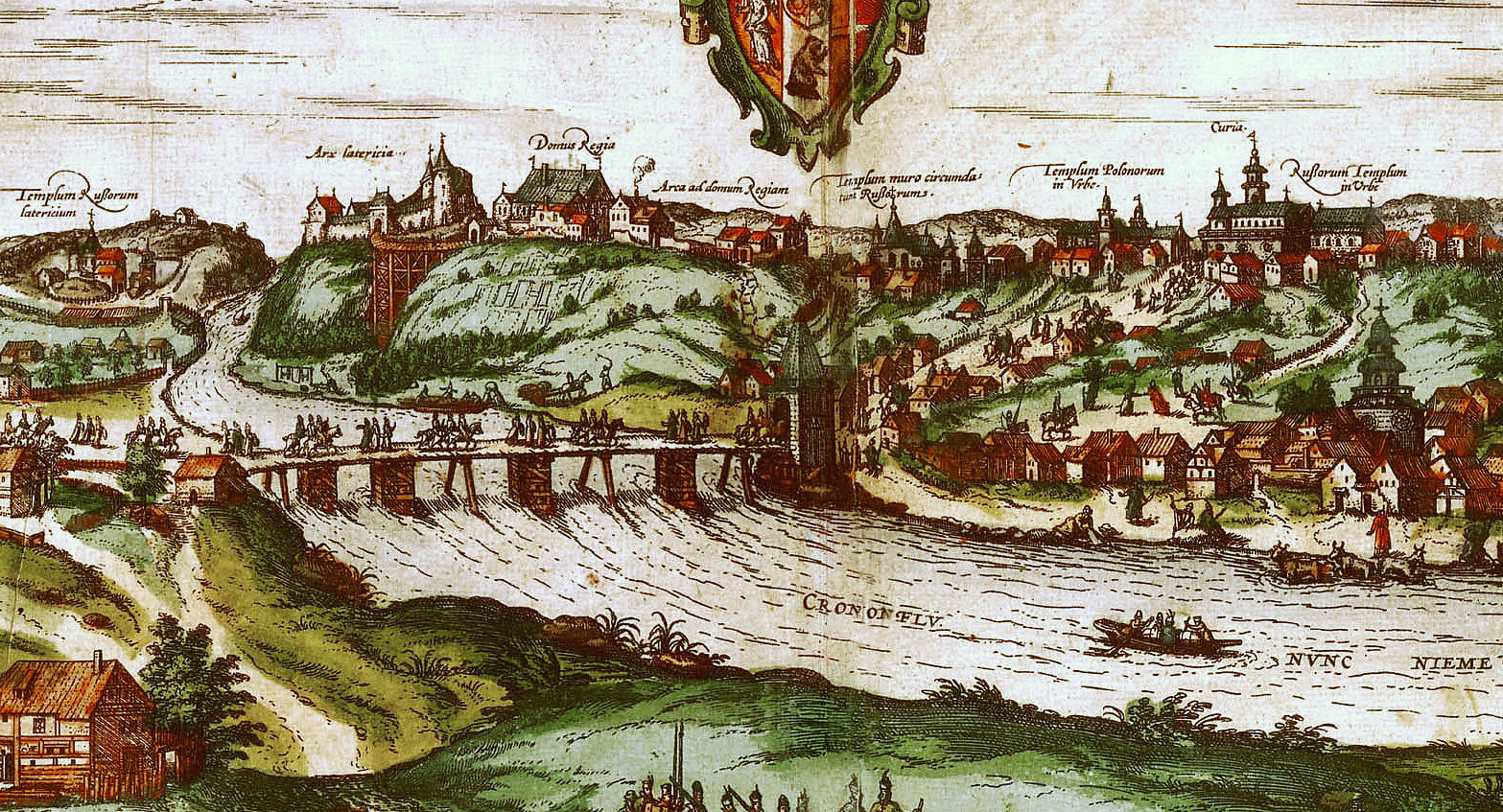
1575 Braun & Hogenberg : "...Grodnae." From "Civitates Orbis Terrarum," first published in
Cologne in 1572. Over a hundred different artists and cartographers engraved copper plates
from drawings, the most significant being Antwerp artist Georg Hoefnagel, who not only
contributed most of the original material for the Spanish and Italian towns but also reworked
and modified those of other contributors, including Munster's German views from the 1550 and
1572 editions of his "Cosmographia." Braun added to the maps figures in local dress, because, he
said, he believed the plans would not then be scrutinized for military secrets by the Turks, as
their religion forbade them from looking on representations of the human form. Also a DETAIL
image. From The Hebrew University of Jerusalem and the Jewish National and University Library
Cologne in 1572. Over a hundred different artists and cartographers engraved copper plates
from drawings, the most significant being Antwerp artist Georg Hoefnagel, who not only
contributed most of the original material for the Spanish and Italian towns but also reworked
and modified those of other contributors, including Munster's German views from the 1550 and
1572 editions of his "Cosmographia." Braun added to the maps figures in local dress, because, he
said, he believed the plans would not then be scrutinized for military secrets by the Turks, as
their religion forbade them from looking on representations of the human form. Also a DETAIL
image. From The Hebrew University of Jerusalem and the Jewish National and University Library


1713 Alphonsus Lasor a Varea (an anagram of Savonarola Raffaello): "Vera
Designatio Urbis in Littauia Grodnae." Padova, Italy. 85 x 135mm, set in text,
from "Universi orbis descriptio ad usum navigantium." A historical prospect of
Grodno based on the Braun & Hogenberg view to the left. In 1562 a summit was
held between the Russians and the Ottomans in the city: in the foreground are
two opulently-dressed figures shaking hands, with their troops of cavalry
behind them. From www.alteagallery.com.
Designatio Urbis in Littauia Grodnae." Padova, Italy. 85 x 135mm, set in text,
from "Universi orbis descriptio ad usum navigantium." A historical prospect of
Grodno based on the Braun & Hogenberg view to the left. In 1562 a summit was
held between the Russians and the Ottomans in the city: in the foreground are
two opulently-dressed figures shaking hands, with their troops of cavalry
behind them. From www.alteagallery.com.
Kovno (Kaunas): founded: 1030? first reference: 1361, in a Teutonic Knights manuascript

1600 Tadas Makovskis: Kaunas
Panoramic View. From www.datos.kvb.lt
Panoramic View. From www.datos.kvb.lt

18th Cent. Royal Palace in Hrodna.

1774 Kaunas city plan.

1860 G. Rober in Raizinys: "Pazaislis
Church." From www.datos.kvb.lt
Church." From www.datos.kvb.lt

1863 E. Roevens, in Le Monde:" Kaunas
view." From www.datos.kvb.lt
view." From www.datos.kvb.lt

1875 N. Orda: "Kaunas City Hall Sq." From
www.datos.kvb.lt
www.datos.kvb.lt

1875 N. Orda: "Old City from Aleksotas
Hill." From www.datos.kvb.lt
Hill." From www.datos.kvb.lt

1893 J. Kamarauskas: "Kaunas Castle in
the 14th-15th Cent." From www.datos.kvb.lt
the 14th-15th Cent." From www.datos.kvb.lt
1840 Barthelemy Lauvergne (painter):
"Vue de Kovno." Lithograph, 9.8 x 16.2
inches. From www.alexandremaps.com
"Vue de Kovno." Lithograph, 9.8 x 16.2
inches. From www.alexandremaps.com

19th Cent. "Kaunas - Old City from the
Northeast." From www.datos.kvb.lt
Northeast." From www.datos.kvb.lt

19th Cent., J. Leczenska: "Pazaislis Church
and Camaldolese Monastery." From
www.datos.kvb.lt
and Camaldolese Monastery." From
www.datos.kvb.lt
Memel (Klaipeda): founding: 1252 by the Livonian Order, which is also date of first reference
Lida (Lyda): founding date generally considered 1380, but there are passing references to Lida in chronicles beginning 1180
1868 P. N. Batiushkov: "Lida Castle," from
"Pamiatniki stariny v zapadnykh
guberniakh imperii." From
www.digitalgallery.nypl.org
"Pamiatniki stariny v zapadnykh
guberniakh imperii." From
www.digitalgallery.nypl.org


1848 "Memel." Red: Old Location 1 = Dom St.
Marien, 2 = rural church of St. Nicholas, 3 =
Church of St. John. Green: New Location 4 =
Church of St. John, 5 = rural Church of St.
Nicholas (later St.Jakobi), 6 = Reformed
Church, 7 = Catholic Church. Blue: the Old
Dange with Mill trench.
Marien, 2 = rural church of St. Nicholas, 3 =
Church of St. John. Green: New Location 4 =
Church of St. John, 5 = rural Church of St.
Nicholas (later St.Jakobi), 6 = Reformed
Church, 7 = Catholic Church. Blue: the Old
Dange with Mill trench.

Great article on the history of town views, from Loeb-Larocque

1623 Braun & Hogenberg: "Grodna - Vera
Designatio Urbis in Littavia Grodnae." 11.9
x 18.7 inches / 30.5 x 48 cm. Copied after
after an engraving by Matthias Zundt,
1568, after a drawing by Johann
Adelhauser, 1567. First edition was 1575.
From www.sanderusmaps.com
Designatio Urbis in Littavia Grodnae." 11.9
x 18.7 inches / 30.5 x 48 cm. Copied after
after an engraving by Matthias Zundt,
1568, after a drawing by Johann
Adelhauser, 1567. First edition was 1575.
From www.sanderusmaps.com
1623 Commentary on Lithuania by
Georg Braun, accompanying his
view of Grodno (above): "Lithuania
is a vast but uncultivated land, east
of Poland, with much grassland and
marshes. The episcopal city of Vilnius
is the capital, and it is as big as
Cracow with all its suburbs. The next
biggest is Grodno, which lies on the
river Cronon, or Memel, partly in the
plain and partly on hilly ground.
There are only a few stone houses
standing together, the houses are
roughly built, with little care; the
city also has no walls or towers, gates
and fortifications. But nearby there is
a castle and a royal palace on the
mountain, there the King of Poland
has his seat."
Georg Braun, accompanying his
view of Grodno (above): "Lithuania
is a vast but uncultivated land, east
of Poland, with much grassland and
marshes. The episcopal city of Vilnius
is the capital, and it is as big as
Cracow with all its suburbs. The next
biggest is Grodno, which lies on the
river Cronon, or Memel, partly in the
plain and partly on hilly ground.
There are only a few stone houses
standing together, the houses are
roughly built, with little care; the
city also has no walls or towers, gates
and fortifications. But nearby there is
a castle and a royal palace on the
mountain, there the King of Poland
has his seat."

1859 Memel city plan.

1700 "Memel in Winter"

1808 "Ansicht von Memel von der West Seite"

19th Cent. Russian plan of "Kovna,"
showing ring of fortresses
showing ring of fortresses

1880 Drawn by Taylor -
Valette, engraved on wood
by Laplante, with added
watercolor: "Bisons of
Bela-Veja Forest (Lituanie)."
From www.french-engravings.com
Valette, engraved on wood
by Laplante, with added
watercolor: "Bisons of
Bela-Veja Forest (Lituanie)."
From www.french-engravings.com
| The following three images are NOT of the Kopgalis fortress at Memel (active from 1865-1871), but of an older fort on the mainland.: From the Military Archive section of the Swedish National Archives (http://www.riksarkivet.se/), which has a singular collection of images of historic fortress plans |


Undated, but probably 18th
century, view of Memel harbor,
from a German source.
century, view of Memel harbor,
from a German source.


1612 Antonio Albizzi (an Italian
genealogist who wound up in
Kempten, Germany): "Regis Poloniae.
Potentiss. Poloniae et Sveciae etc.
Regi Sigismundo III," Augsburg. "The
Kings of Poland," a family tree on a
back- ground view of Grodno. 42.3 x
56.8 cm. From
www.oldtimesrarebooks.com
genealogist who wound up in
Kempten, Germany): "Regis Poloniae.
Potentiss. Poloniae et Sveciae etc.
Regi Sigismundo III," Augsburg. "The
Kings of Poland," a family tree on a
back- ground view of Grodno. 42.3 x
56.8 cm. From
www.oldtimesrarebooks.com

1895 Gustav Heuer: "Winternacht in
Litauen," (A Winter's Night in Lithuania),
Berlin, 220 x 319 cm woodcut. My father used
to tell of, as a boy, watching for wolves at
night, holding a rifle. AK, Originally from
www.antykwariat.biz
Litauen," (A Winter's Night in Lithuania),
Berlin, 220 x 319 cm woodcut. My father used
to tell of, as a boy, watching for wolves at
night, holding a rifle. AK, Originally from
www.antykwariat.biz

1883 Joseph Ryszkiewicz: "PONOCNY NA
ZMUJDZL," (The Samogitian Night
Watchman), 121 x 168 cm, colored
woodcut. AK, Originally from
www.antykwariat.biz
ZMUJDZL," (The Samogitian Night
Watchman), 121 x 168 cm, colored
woodcut. AK, Originally from
www.antykwariat.biz

1889 "WIDOK OGOLNY KOWNA" (View of
Kaunas), Krakau, page 15 of "Album
Souvenirs of Adam Mickiewicz," published
by H. Altenberg. From www.antykwariat.biz
Kaunas), Krakau, page 15 of "Album
Souvenirs of Adam Mickiewicz," published
by H. Altenberg. From www.antykwariat.biz

1650 "Memel Althof"

1887 Kazimierz Pomianowski: "BRZEGI
POLAGI" (The Shore at Palanga), 115 x 157
cm, from The Illustrated Weekly, of
August 25, 1887. From www.antykwariat.biz
POLAGI" (The Shore at Palanga), 115 x 157
cm, from The Illustrated Weekly, of
August 25, 1887. From www.antykwariat.biz

1881 Andrew Zajkowski: "W
puszczy litewskiej," (In the
Lithuanian Forest) From
www.antykwariat.biz
puszczy litewskiej," (In the
Lithuanian Forest) From
www.antykwariat.biz